
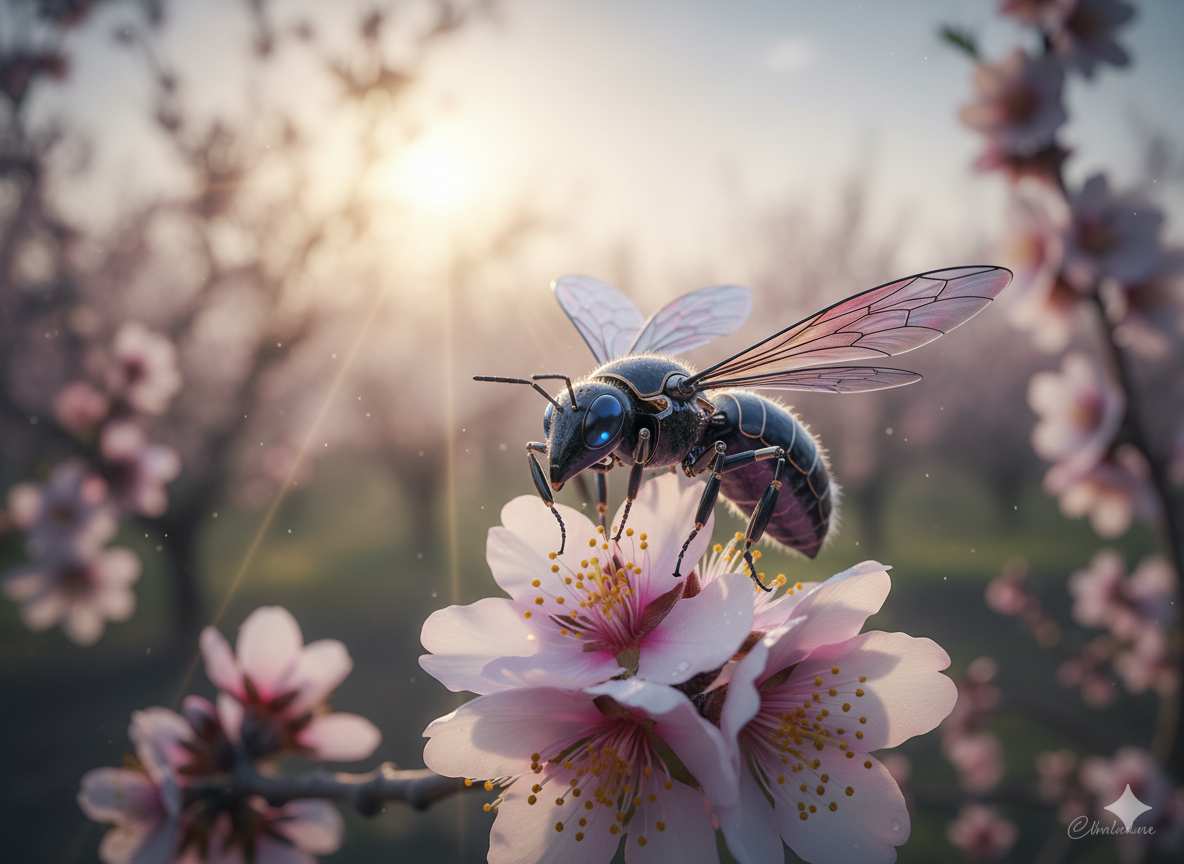
Imagine a Californian all-almond orchard in the morning. One should hear the buzz of billions of bees. Rather, there is a weak, mechanical whir. There is a swarm of robot opponents whose size is not greater than that of a dragonfly and whose movements are subtle and crucial dance moves. This isn’t science fiction. It is the vanguard of an unspoken crisis – and a technological fix that would transform our world.
We are experiencing the disappearance of pollinators. They are the food crops on which over 30 percent of our food crops are parasite. What happens if they vanish? AI Robotics is intervening, but the question is, are we solving a problem or are we creating a new one?
Engineering the Un-Bee
The humanoid robots are cumbersome. The real innovation is micro. The companies such as Arugga AI Farming in Israel are on the frontline. Their bee robots do not resemble bees. They employ advanced computer vision in order to detect particular flowers. A specific air pulse is then an imitation of the buzz pollination of bumblebees. This is micromanaging agriculture.
The important aspects of this technology are:
- High-tech Sensors: They enable the robot to detect the readiness of a flower.
- Machine Learning Algorithms: They visualize the most optimal route of pollination.
- Pollen transferring Actuators that are delicate: These are actuators that transfer pollen without destruction.
It is not aimed at imitation of nature. It is to mimic the role. And under regulated conditions, it is working.
A Real-World Test Case
Consider the tomato. The plants in most greenhouses are pollinated by human beings using vibrating wands. It is labor intensive and costly. Arugga has now robots that move on their own through these rows. They work all night. They don’t get tired. Initial data represents a positive 5-10 percentage point gain in certain trial studies. This shows the commercial viability of the concept at the present point of time.
Meanwhile, the tech giant Walmart received a patent of autopiloted “robot bees” in 2018. This depicts that big companies are betting this future. There is a mad race to perfect this technology before it is late.
The Underground Truths in the Hive
So, what’s the catch? The use of these machines in the open is extremely dangerous. Would they be able to physically abuse actual bees? Do they have a competition over limited resources of pollen? It is a mystery we do not even know that Dr. Dave Goulson, a well-known bee expert has cautioned that do not over-fix easily.
He says, The foresight of armies of robot bees having our crops under eternal surveillance, is a dystopian nightmare. The ultimate and only way is to mend our relationship with the natural world.
His point is crucial. Robotics is not an aid but a crutch. We are tempted to put aside native habitats to the extent they can be replaced by a technical Band-Aid. It is the essence of the dilemma.
Other than Pollination: The Data Harvest
These devices have much more to offer. Every robo bee is an aerial sensor of information. In their androgynous approach to flowers, they are able to gather colossal quantities of information. They are able to identify early stages of fungus. They are able to observe the soil moisture on a plant level. These bees are able to monitor the growth of fruits.
This provides a highly precise image of the health of crops. Water and fertilizer can then be applied with precise targeting of farmers. This helps to minimize wastage and environmental effects. It is not only the pollination, but the smartness that is valuable.
An Ecologist’s Worry
I interviewed a conservation biologist who did not want to be disclosed because of his/her connections with one of the large agri-tech projects. They presented a very sharp point of view. They were creating a system they do not completely understand, they told me. What in case these machines spread pathogens accidentally? What would happen when they interfere with bee communication through frequency of occurrence?
They included, everybody is obsessed with the hardware. However, the actual wild card is the software or the AI. There would be unintended consequences of an act of unexpected behavior in a swarm of thousands.
This understanding moves the issue out of mechanical terms to the intelligence. The actual unknown variable is the AI Robotics that control the swarm.
The Way Humanity Can move forward: Coexisting rather than Replacing
The solution is not to give up on this technology. It’s to deploy it wisely. This can be best utilized in controlled environments. The ideal ones are vertical farms and greenhouse companies. In this case, the use of robots is ecologically safe. They are able to provide food security at urban centers.
In the case of open fields, they are supposed to be a last resort and not an initial choice. Healing the land has to be our major concern. Pollinator highways need to be planted. We must reduce pesticide use. Technology and nature should not be used antagonistically.
The Final Verdict
The humming of the orchard is varying. It is inevitable that robotic pollinators will emerge. It is a magnificent product of human invention. But it is evidence of our inability to take good care of the planet.
We are constructing an artificial leg to nature. And with it as a means of recovery rather than a substitute. Our future food is based on a symbiotic relationship between the natural and the machines that we construct. The choice is ours. Will we heark the sound of nothing that we have made, or merely of the whirling of what we have made?